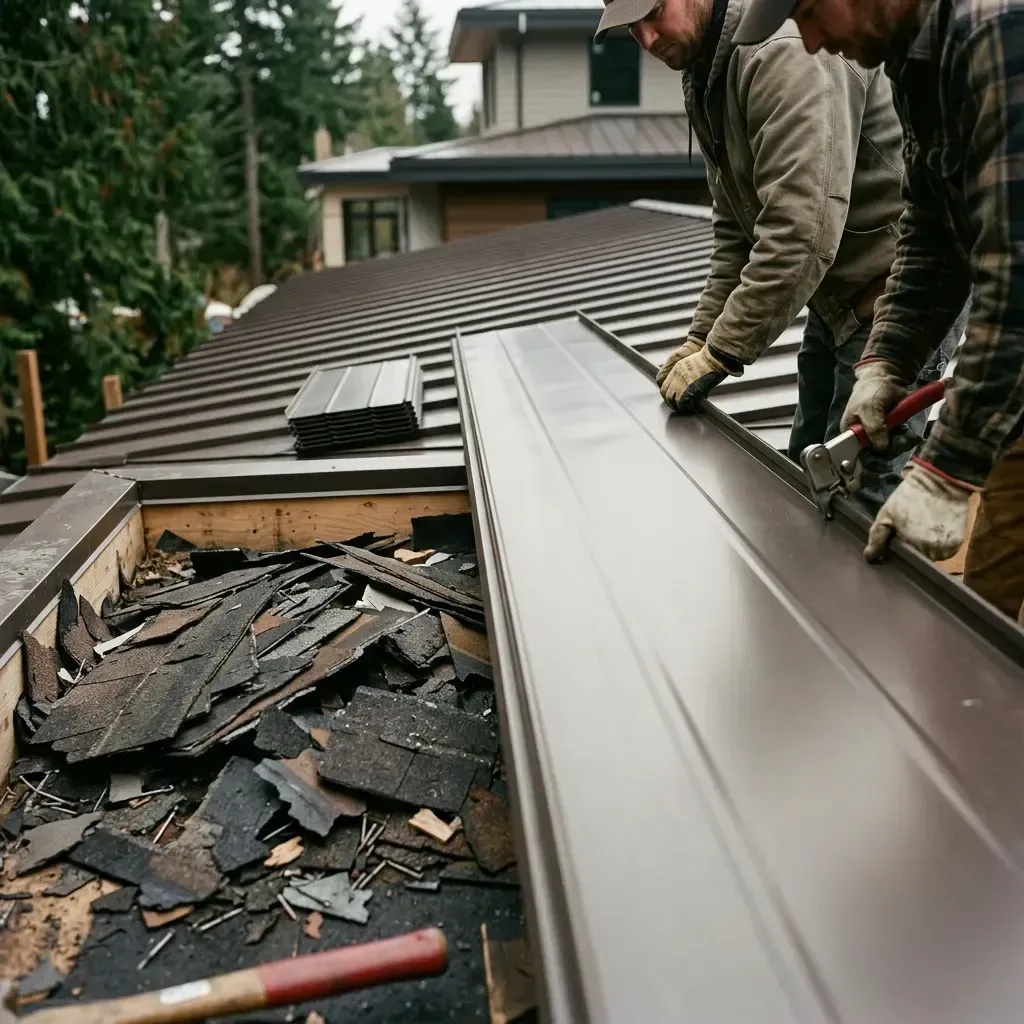
Metal Roofing Leads Green Building Rankings With 100% Recyclability
Metal Roofing Leads Green Building Rankings With 100% Recyclability

Your roof replacement generates waste. The question is how much and for how long.
When we install a metal roof, we're working with material that achieves 100% recyclability at end-of-life. Every panel, every scrap from installation, every piece of tear-off material loops back into new products without quality loss. Steel, aluminum, copper, zinc—all of it returns to the manufacturing stream.
Compare that to asphalt shingles. Only 1-10% get recycled in practice. The remaining 90% sits in landfills for 300-400 years, contributing to the 20 billion pounds of shingle waste dumped annually in the U.S.
The Environmental Math Changes With Lifespan
Metal roofing often starts with 25-95% recycled content before installation. Aluminum roofs frequently contain 95% recycled material from consumer products. Steel typically ranges from 25-35% or higher.
This recycled content slashes embodied energy dramatically. Producing recycled aluminum requires just 5% of the energy needed for virgin aluminum. Recycled steel uses roughly 26% of virgin steel's energy requirements.
But the real environmental advantage shows up over time.
Asphalt shingles last 15-30 years. Over a typical 50-60 year homeownership period, you'll replace them 2-3 times. Each replacement adds manufacturing emissions, transportation impacts, installation energy, and landfill contributions.
A well-installed metal roof lasts 40-70+ years. One installation. No repeats.
Studies show metal's lifetime embodied carbon per year of service ends up 30-70% lower than asphalt when you factor in multiple replacements. You're saving thousands of kg of CO2e while avoiding massive waste generation.
Energy Efficiency You Can Measure
Homeowners with reflective metal roofs report cooling cost reductions ranging from 10-40%, with most landing in the 20-30% range for summer electricity use. That translates to annual savings of $200-$800 or more, depending on your location and home size.
The physics are straightforward. Metal roofs with modern coatings reflect 40-70% of solar energy. Asphalt shingles absorb 70-95% of it.
When asphalt surfaces hit 150-190°F on sunny days, they radiate that heat downward into your attic. Metal surfaces with cool coatings stay 30-100°F cooler under the same conditions. Lower roof temperatures mean lower attic temperatures, which means your AC works less.
Less energy consumption means fewer fossil fuels burned at power plants. Your individual choice reduces grid strain during peak demand, lowers greenhouse gas emissions, and contributes to cleaner air in your community.
The Recycling Loop That Actually Works
Metal maintains its quality through infinite recycling cycles. The atomic structure doesn't degrade like petroleum-based materials.
Here's what happens when your metal roof reaches end-of-life:
Panels get collected and sorted by metal type using magnets and scanners
Material is shredded to increase surface area for efficient melting
Coatings vaporize during melting while impurities get skimmed off
Precise alloying restores desired strength and corrosion resistance
Molten metal is cast into sheets ready for new panels
The result performs identically to virgin material. Your old roof becomes someone's new roof, car parts, or aluminum cans. The loop continues without environmental penalty.
Asphalt can't loop like this. Its complex petroleum-bitumen mix with fiberglass breaks down chemically. When recycling happens at all, it downgrades into lower-grade road filler. Most just sits in landfills, slowly releasing contaminants into groundwater.
The Market Is Shifting
The global metal roofing market hit $22.55 billion in 2024 and projects to reach $32.83 billion by 2032. In the residential sector, 72% of contractors expect growth in 2025.
Stricter building codes are rewarding reflective roofs for lower cooling loads. Insurance companies are ramping up discounts for impact-resistant materials as extreme weather becomes more common. Homeowners are starting to see metal not as a premium upgrade but as the practical, future-proof baseline.
The math is becoming clearer. Metal pays for itself through energy savings, fewer replacements, higher resale value, and lower insurance premiums.
What Homeowners Say After Two Years
The most common response we hear: "I wish I'd done this sooner."
After experiencing cooler attics in summer, noticeably lower utility bills, and zero worries during storms, homeowners express genuine surprise at how much better everyday life feels. The regret isn't about the roof itself—it's about waiting so long to upgrade from shingles that kept forcing repairs and replacement anxiety.
Your roof choice affects more than your home. It influences landfill waste, grid stability, urban heat islands, and carbon emissions. Metal roofing offers a path to protection that doesn't compromise environmental responsibility.
We install roofs built to last generations, not decades. That's the difference between a sustainable choice and a temporary fix.
