The Real Math Behind Solar-Ready Metal Roofs in Pennsylvania
The Real Math Behind Solar-Ready Metal Roofs in Pennsylvania

Pennsylvania homeowners looking at their energy bills and aging roofs at the same time are missing one critical calculation.
A standing seam metal roof with cool-pigment coating drops summer attic temperatures by 40-60 degrees. That temperature drop cuts air conditioning costs by 18-25% every single year.
On a typical Central Pennsylvania home spending $250 monthly on summer cooling, you're looking at $600-$800 saved annually. Over 20 years, that's $12,000-$16,000 back in your pocket—before you even add solar panels to the equation.
Most homeowners see the higher upfront price and stop there. They never run the 20-year math where the "expensive" metal roof actually generates thousands in savings while cheap asphalt keeps draining their wallet every July.
What Happens When You Add Solar to Standing Seam

Installing solar panels on standing seam metal roofs changes the financial picture completely.
You clip panels directly to the raised seams without drilling a single hole. That saves $3,000-$5,000 in installation labor compared to asphalt, where crews drill 60-120 penetrations through your roof and pray the sealant holds through Pennsylvania's freeze-thaw cycles.
The metal's reflectivity keeps solar panels 10-15°F cooler, boosting energy output by 3-5%. That efficiency gain stacks on top of your $12,000-$16,000 in cooling savings over 20 years.
A 10kW system runs $25,000-$30,000 after the 30% federal tax credit, with payback in 6-8 years from $1,500 annual bill offsets.
Wait five years to retrofit solar onto asphalt? You're ripping up shingles for $15,000-$25,000, pulling panels for $4,000-$6,000 in labor costs, then reinstalling everything while electricity rates climb 5-7% annually. Your payback stretches to 10-12 years, and you're risking leaks that void warranties.
The Leak Factor Nobody Talks About

Standing seam clamp systems like S-5! show near-zero leak failure rates over decades. Industry data from NREL indicates no reported leaks from proper clamp installations in 10-20 years.
Penetration-based asphalt installations? They start under 1% leak rates in the first few years if flashed correctly. But sealant breakdown pushes failure rates to 5-10% by year 10-20, climbing to 20-30% over 30 years from weathering.
When that leak hits at year 12 or 15, the bill runs $5,700-$12,000. The solar crew disconnects and removes 8-15 panels ($2,500-$5,000), roofers tear off damaged shingles and replace rotted decking ($1,200-$3,000), then panels go back up with full inspections ($2,000-$4,000).
You're also losing power generation for weeks, plus potential interior mold cleanup if water reached your attic.
The 30-Year Maintenance Reality

A standing seam metal roof with solar installed today needs minimal maintenance over three decades.
Budget for an inverter replacement around year 15 ($2,000-$3,000) and possibly a full array replacement at year 25 if efficiency drops below 80% ($10,000-$15,000). Add $200-$400 yearly for inspections and a touch-up paint job every decade to prevent corrosion from Pennsylvania's salty air.
Total over 30 years: under $20,000, mostly preventive maintenance that keeps warranties valid and power generation consistent.
No leak drama. No emergency repairs. No downtime.
Property Value Impact

When appraisers evaluate two identical $400,000 Central Pennsylvania homes—one with a five-year-old asphalt roof, the other with a solar-ready standing seam metal roof and panels—they write down a $25,000-$45,000 premium for the metal and solar setup.
Metal roofing alone boosts value 1-6% through curb appeal and durability ($4,000-$24,000). Solar panels add another $20,000-$30,000 from energy savings and green appeal, according to Zillow and appraisal data.
The asphalt roof barely moves the valuation needle.
The Cash Flow Timeline

Finance a $35,000 standing seam plus solar system over 15 years at 6.5%, and you're paying $305 monthly. Subtract $125 in immediate energy savings from lower bills and solar power, and your net outflow drops to $180 per month.
A $12,000 asphalt replacement costs $105 monthly with zero savings to offset it.
You're paying an extra $75 net per month for the upgrade. That breaks even around month 236—roughly 19 years and 8 months from installation.
Once the solar loan ends at year 15, your $128 monthly energy and insurance gains kick in full force while the asphalt owner starts paying for their second roof. You pull ahead by $200 that month and widen the gap by $223 every month after.
The upfront investment turns into $50,000-plus net savings over 30 years.
Who Should Skip This Investment

This isn't right for everyone.
If you're planning to sell or downsize in under 10 years, you'll never hit payback. You'll leave most of that $25,000-$45,000 appraisal bump on the table for the next owner.
Anyone on a tight monthly budget where an extra $75 creates financial stress should reconsider. Same for homeowners with heavy tree shade killing solar output or roofs facing north under mature oaks.
If you're moving soon, cash-strapped today, or dealing with serious shade issues, stick with basic asphalt and let the long-term buyer cash in on the upgrade.
The One Question That Matters

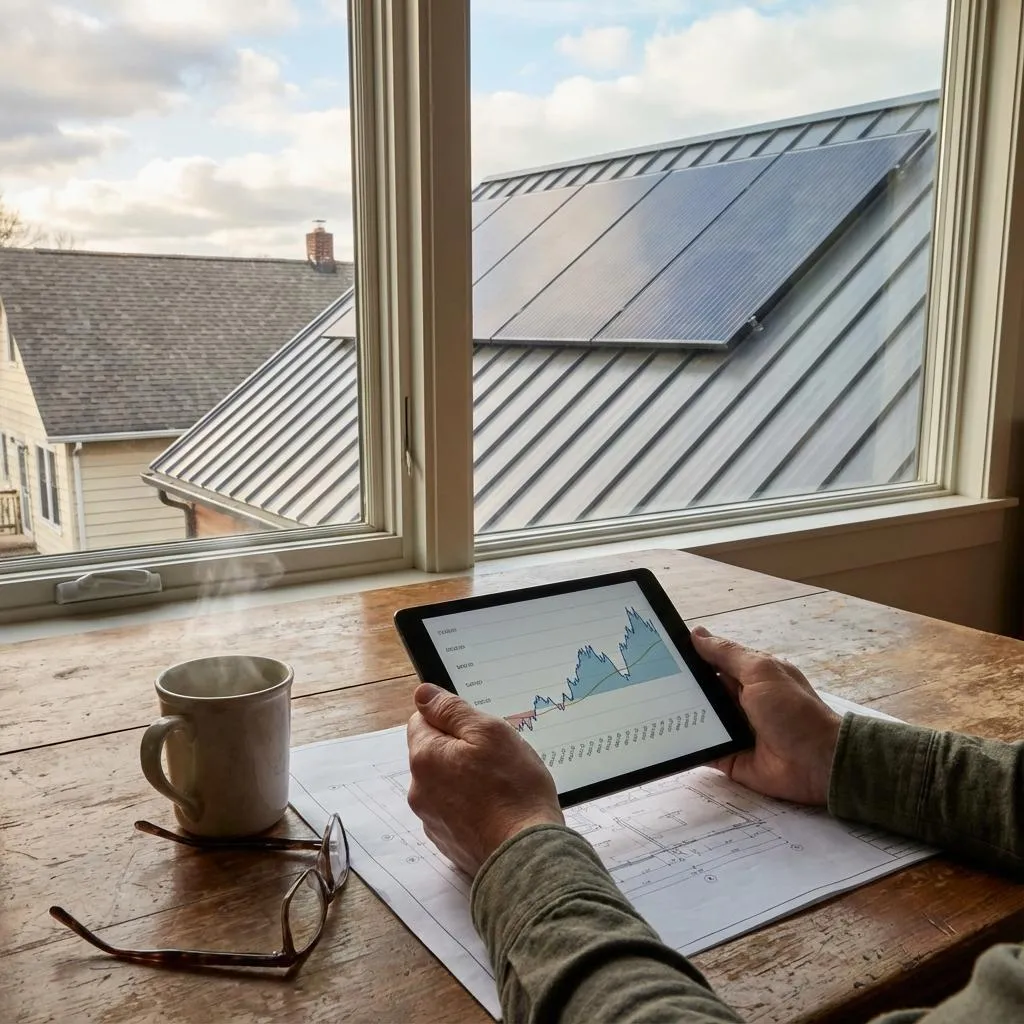
Sitting at your kitchen table with all this data in front of you, ask yourself one simple question:
"Am I going to own this house and pay these energy bills for the next 15 years or more?"
If the honest answer is yes, standing seam plus solar is a clear financial win. If you're moving, downsizing, or flipping soon, walk away and save the cash.
Everything else—storm protection, insurance discounts, environmental benefits—falls into place once you answer that single question.
We've installed hundreds of these systems across Pennsylvania. The homeowners who commit to staying put see the full financial benefit. The ones who move early leave money on the table.
The math doesn't lie. Your timeline determines whether this investment makes sense for you.
